If you are covering a whole house, plantation shutters earn their price on the windows people see from the street and the windows you actually operate every day, and custom blinds are the sensible choice on secondary bedrooms, hallways, and anywhere the window count is driving the budget. Almost nobody we quote in Ventura County ends up with one product everywhere — the usual outcome is shutters on the front elevation and the main living spaces, blinds or shades on the rest.
Why this comes up in almost every Conejo Valley walkthrough
The housing stock here is the reason. A 1990s plan in Dos Vientos, Wood Ranch, or Big Sky routinely has 22 to 30 openings: a two-story entry window, a tall living room wall, three or four sliders, secondary bedrooms with a pair of windows each, and a handful of small bathroom and laundry windows nobody thinks about until the quote arrives.
Estate and equestrian lots in Lake Sherwood, North Ranch, and Spanish Hills push that count higher and add oversized openings, arched transoms, and glass that faces open land with no neighbor in sight — which changes the privacy math completely.
Then there is exposure. Inland, the problem is afternoon sun and Santa Ana dust: Simi Valley, Moorpark, and Thousand Oaks get long hot afternoons and a couple of weeks a year where fine grit works its way through every window seal in the house. Toward Ventura, Oxnard, and Camarillo you get morning fog, salt in the air, and a much gentler light load. Santa Paula and Ojai sit somewhere in between, with real heat and real dust.
So the honest answer to "blinds or shutters" is not a product verdict. It is a sorting exercise across your specific openings.
In Ventura County? Get a free quote from a local installer
Send us your window sizes and a few photos and we'll quote you, usually the same day. Want us to come out with samples and measure? The consultation is free. Call or text us three days and times that work.
Serving Thousand Oaks, Newbury Park, Westlake Village, Oak Park, Simi Valley and nearby.
Light, privacy, and what each one does at the edges
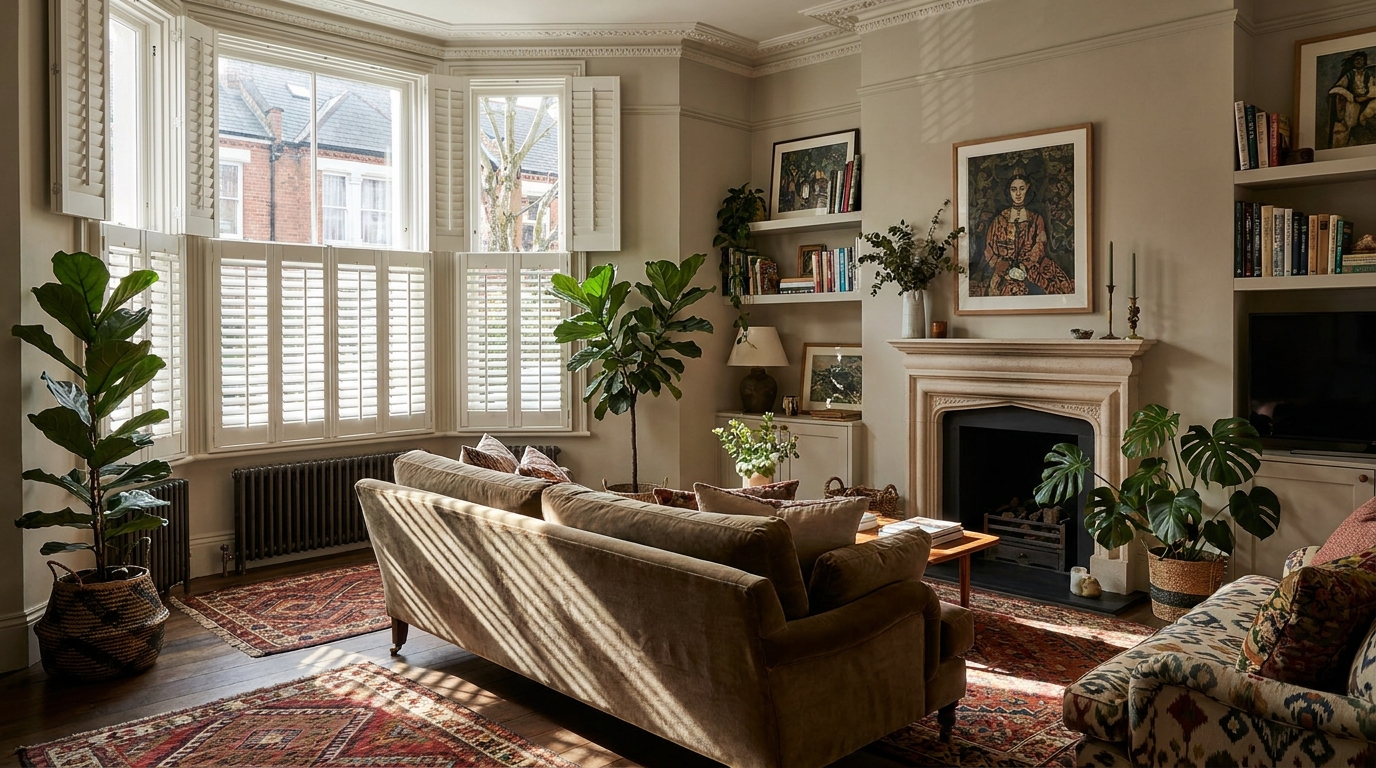
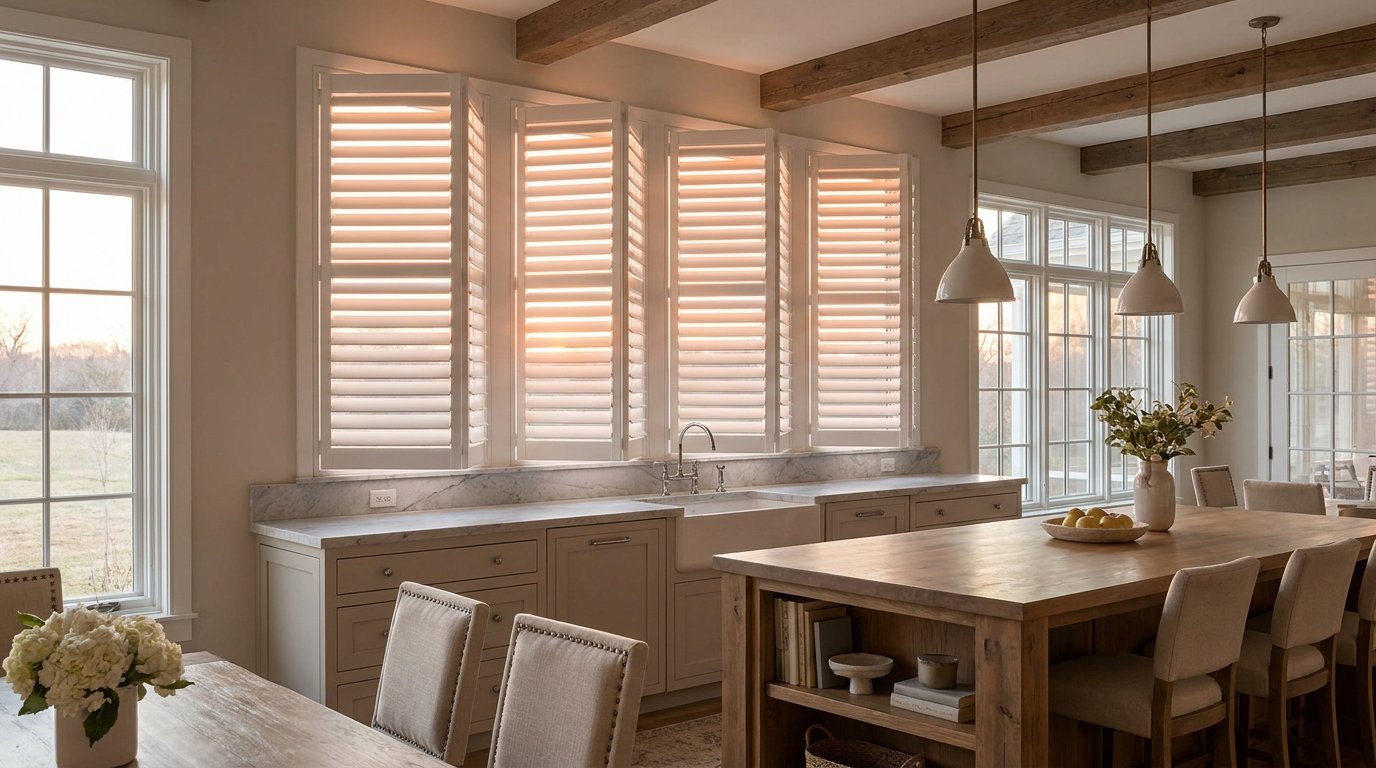
A plantation shutter is a rigid framed panel with louvers, usually 2 1/2, 3 1/2, or 4 1/2 inches wide, mounted into the window opening. You tilt the louvers for light, and you can swing the panels fully open when you want unobstructed glass. The frame semi-seals the perimeter, which is why a closed shutter darkens a room more thoroughly than most blinds.
A custom wood or faux wood blind is a stack of 2-inch slats on a ladder cord or cloth tape, raised and lowered on a lift system and tilted with a wand. It does the same two jobs — tilt for light, raise for view — but it does them differently at the edges:
- Route holes. Standard blinds have lift cords running through holes in each slat, and those holes pass small dots of light even when closed. Cloth tape hides them visually but the pinholes are still there. It matters in a bedroom, not in a hallway.
- Side gaps. An inside-mounted blind needs clearance to operate, so there is a gap at each side. A shutter frame covers that gap.
- Stack. Raised, a 2-inch blind piles up several inches at the top of the window. A shutter never stacks — the panels swing to the side — which is why shutters look cleaner on a window you look through all day.
Where blinds win on light control is the top-down move. Many blinds and shades can be lowered from the top or raised from the bottom, which gets you daylight and privacy at the same time on a street-facing bedroom in a tight Newbury Park tract. A shutter with a divider rail does something similar, but you decide the rail height at order time and live with it.
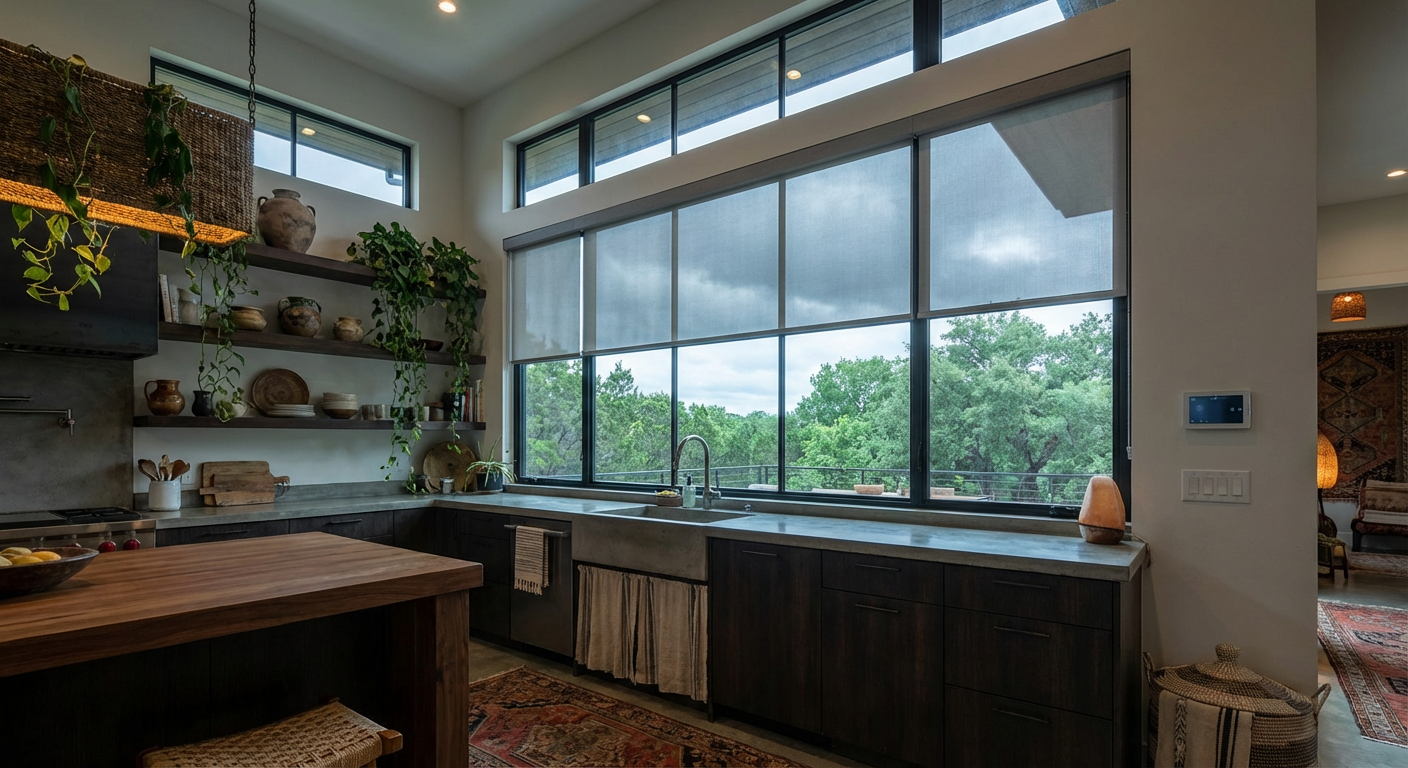
On sliders and very wide openings, the two products diverge. Bypass shutter tracks work, but they are heavy, they need clearance, and the panels always live somewhere in front of the glass. A vertical blind or a roller shade often handles a 10-foot slider more gracefully. We covered the heat side of that tradeoff in our post on shutters versus shades in hot rooms.
Heat, dust, and what survives a Ventura County summer
On pure heat, both are interior products, which means the sun has already passed through your glass before either one gets a vote. Closed shutters do better than closed blinds because the panel is thicker, opaque, and sealed at the perimeter — you get a pocket of still air against the glass. Blind slats leak through the gaps between them no matter how tightly you tilt.
Durability is where the local conditions actually decide things.
Inland dust. Every horizontal surface collects Santa Ana grit. A 2-inch blind on a 5-foot-tall window has roughly 30 slats, each with two faces. A 4 1/2-inch shutter on the same window has about 13 louvers. Fewer, wider surfaces means less time with a cloth, which is not a small consideration if you are cleaning 25 windows.
Sun and finish. Real wood blinds on a west-facing window in Moorpark will fade and can warp over years of direct exposure. Faux wood resists that but sags on wide spans, which is why there is a width limit on any faux wood blind and why a wide opening may need two blinds on one headrail. Painted composite or hardwood shutters hold their finish and their shape better under the same sun.
Coastal air. In Oxnard and beach-side Ventura, humidity and salt are the enemy, and painted composite shutters or faux wood blinds both do fine. Stained hardwood in a bathroom with an ocean-facing window is the combination we steer people away from.
Cleaning. Shutter louvers wipe with a damp microfiber and a dry pass. Blinds take longer and the cords and tapes eventually show dirt you cannot fully clean out. Neither is difficult; shutters are just faster per window.
What the money actually looks like across 25 openings
Shutters are priced by the square foot; blinds and shades are priced per window. That difference is the whole reason mixing works.
Plantation shutters run $55 to $106 per square foot installed, with a 12 square foot minimum billable per opening. Wood and faux wood blinds run $250 to $650 per window installed. Roller, solar, zebra, and cellular shades run $495 to $955 per window, with motorization adding $200 to $500 per shade.
Run that against two real openings:
- A 4-foot by 5-foot living room window (20 sq ft). Shutters land in the $1,100 to $2,120 range. A faux wood blind on the same window lands in the $250 to $650 range.
- A 2-foot by 3-foot bathroom window (6 sq ft). Because of the 12 square foot minimum, shutters bill as 12 square feet — $660 to $1,272. A blind on that window is still $250 to $650.
That minimum is standard across the trade and it is the single biggest driver of whole-home shutter quotes in houses with a lot of small openings. If your plan has six bathroom and laundry windows, you are paying a shutter minimum on all six. Anyone quoting you a whole house should be able to show you that line by line — see our quote comparison checklist for what to ask for.
How we'd actually split a house, room by room
Curb appeal is a real factor and it is worth being specific about. Shutters read as a permanent architectural feature from the street because the louvers are all one color and all at the same angle. Blinds read as a covering, and a row of front-facing windows where each blind sits at a slightly different height is the most common way a nice elevation looks unkempt. On the front of a house in North Ranch or Spanish Hills, that uniformity is most of what you are buying.
Resale-wise, appraisers do not line-item window coverings, but buyers notice shutters and generally read them as included with the house. Blinds read as replaceable. That is perception, not appraised value — worth something, not worth stretching for.
A split that works for most houses here:
- Shutters: front elevation windows, the living and dining rooms, the primary bedroom, and any office you sit in all day.
- Blinds: secondary bedrooms, hallways, laundry, bathrooms with small windows, and garage-side openings.
- Shades: the west-facing rooms that actually overheat, big sliders, and anywhere a view matters more than the frame around it.
Matching across a mixed house is doable if you plan it: hold the whites to one tone, keep the mount type consistent, and decide at order time whether you want the blinds visually quiet or matched to the shutter color.
If you want that sorting done on your actual floor plan, book an in-home visit. Someone comes out, measures every window, brings real shutter and blind samples to hold against your walls and light, and you get a firm quote with install included, and the in-home consultation is free. If you already have a bid in hand, upload it to our free Quote Check tool first.
Frequently asked questions
Is it odd to have shutters in some rooms and blinds in others?
No. It is the most common outcome we quote in Thousand Oaks, Simi Valley, and Camarillo. Shutters go on the front elevation and main living spaces where they are seen and used daily; blinds or shades cover secondary bedrooms, hallways, and small utility windows. Keep the whites in one tone family and the mount type consistent and a mixed house reads as intentional.
Why do shutters cost so much on a small bathroom window?
Shutters are billed by the square foot with a 12 square foot minimum per opening, which is standard across the industry. A 2-by-3-foot window is only 6 square feet but bills as 12, so at $55 to $106 per square foot it lands in the $660 to $1,272 range installed. A wood or faux wood blind on the same opening runs $250 to $650.
Do plantation shutters block more heat than blinds?
Closed, yes. A shutter panel is thick, opaque, and framed into the opening, so it traps a pocket of still air against the glass. Blind slats leak between the slats and around the sides no matter how tightly you tilt them. But both are interior products, and on a genuinely hot west-facing window a solar or cellular shade often outperforms either.
Which holds up better in Santa Ana dust and inland sun?
Shutters, on both counts. Wider louvers mean fewer surfaces to wipe, and painted composite or hardwood holds its finish and shape under direct sun better than real wood blinds, which can fade and warp. Faux wood blinds resist sun well but sag on wide spans, which is why very wide openings often need two blinds on one headrail.
Can shutters work on a 10-foot slider?
Bypass shutter tracks exist and they work, but the panels are heavy, they need clearance, and they always sit somewhere in front of the glass. On the big sliders common in 1990s and 2000s plans here, a roller shade or a vertical treatment usually operates more easily and gives you the full opening when you want it.
In Ventura County? Get a free quote from a local installer
Serving Thousand Oaks, Newbury Park, Westlake Village, Oak Park, Simi Valley and nearby.
- Quote from your window sizes and photos, usually the same day
- See real samples in your space
- We carry every major manufacturer