If the slider is your main way out to the patio and it gets used ten or twenty times a day, the realistic replacements are a sliding panel track, bypass or bifold shutters, or drapery on an extended rod — all three let you push the covering aside and walk through without touching it again. Roller and solar shades are the better answer on a slider you rarely open, because they give back every inch of glass when raised but have to be raised and lowered on each trip.
Why verticals die first on the patio door, and what's actually wrong with them
Most of the sliders we look at in Thousand Oaks, Newbury Park and Simi Valley came with builder vertical blinds in the 1990s or early 2000s. Thirty years later the complaint is always the same short list: two or three vanes missing, the carrier stems snapped, the chain tangled, and a wand that no longer tilts the whole bank together.
That's not bad luck. A vertical blind is a row of loose vanes hanging from small plastic carriers in an aluminum track, and every pass through the door puts a sideways load on the one part that isn't designed for it. Add a dog nosing through, kids pushing vanes aside instead of stacking them, and a Santa Ana that grabs the whole bank when the door is open, and the carriers go first.
The second complaint is dust. Inland Ventura County summers coat everything, and a vinyl or fabric vane holds it. In Dos Vientos, Wood Ranch and Big Sky, where the wind comes off open hillsides, homeowners tell us they're wiping vanes every few weeks and the vanes still look gray.
Verticals do have one genuine advantage worth naming before we replace them: they tilt and stack. You can close them for privacy without covering the glass permanently, then slide the whole bank to one side. Only one replacement does both of those things, and it's a shutter.
In Ventura County? Get a free quote from a local installer
Send us your window sizes and a few photos and we'll quote you, usually the same day. Want us to come out with samples and measure? The consultation is free. Call or text us three days and times that work.
Serving Thousand Oaks, Newbury Park, Westlake Village, Oak Park, Simi Valley and nearby.
Stack-back is the number that decides this, not the fabric
Stack-back is how much of your opening the treatment still covers when it's fully open. It is the single most useful number on a slider, and almost nobody quotes it unless you ask.
Here's what to expect on a standard 96-inch (8-foot) slider, and why the choice changes on a 144-inch or 192-inch door:
| Treatment | Typical stack on a 96" slider | Where the stack sits |
|---|---|---|
| Vertical blind | 12–18" to one side | Over the glass, flat to the door |
| Sliding panel track | One panel width plus a few inches, often 26–36" | Over the glass, panels nested |
| Bypass shutter | Half the opening, roughly 48" | Over the glass, permanently |
| Bifold shutter | 8–12" per side | Folded panels project into the room |
| Drapery on an extended rod | 0" over glass if the rod runs past the jambs | On the wall beside the door |
| Roller or solar shade | 0" over glass, 3–4" roll at the header | Above the opening |
Two things follow from that table. First, if the reason you're spending money is the view of the pool or the Conejo hills, drapery and roller shades are the only options that clear the glass completely. Second, a bypass shutter always leaves half the door covered, which is fine on a 12-foot slider where half is still six feet of open glass and a real problem on a 6-foot door.
The five real options, rated for daily traffic
Sliding panel tracks
Wide fabric panels, usually three to five, riding in a head track and stacking behind one another. This is the closest thing to a modern vertical blind: push it aside, walk through, leave it. Panels can be solar screen fabric, so you keep some view and cut glare, or a light-filtering weave for privacy. Downsides: no tilt function, so a panel is either in front of the glass or it isn't, and the stack is wide. On a 144-inch slider in a North Ranch great room, a five-panel track stacks close to three feet.
Bypass and bifold shutters
Shutters are the only replacement that keeps the tilt-and-stack behavior you liked about verticals. Louvers tilt for privacy and glare while the panels stay put, which on a door you walk through constantly is a real advantage — most days you never move the panels at all. Bypass panels slide on a track and cover half the opening permanently. Bifolds fold back and clear more glass but need floor clearance and project into the room, which rules them out where a sofa or dining chair sits close to the door.
Shutters are also the easiest surface here to keep clean: a wipe, not a wash. On the dust question alone they beat fabric on an inland lot. Figure $55 to $106 per square foot installed, with a 12 square foot minimum billable per opening, which makes a slider one of the larger single line items in a quote — an 8-foot door is about 56 square feet.
Drapery
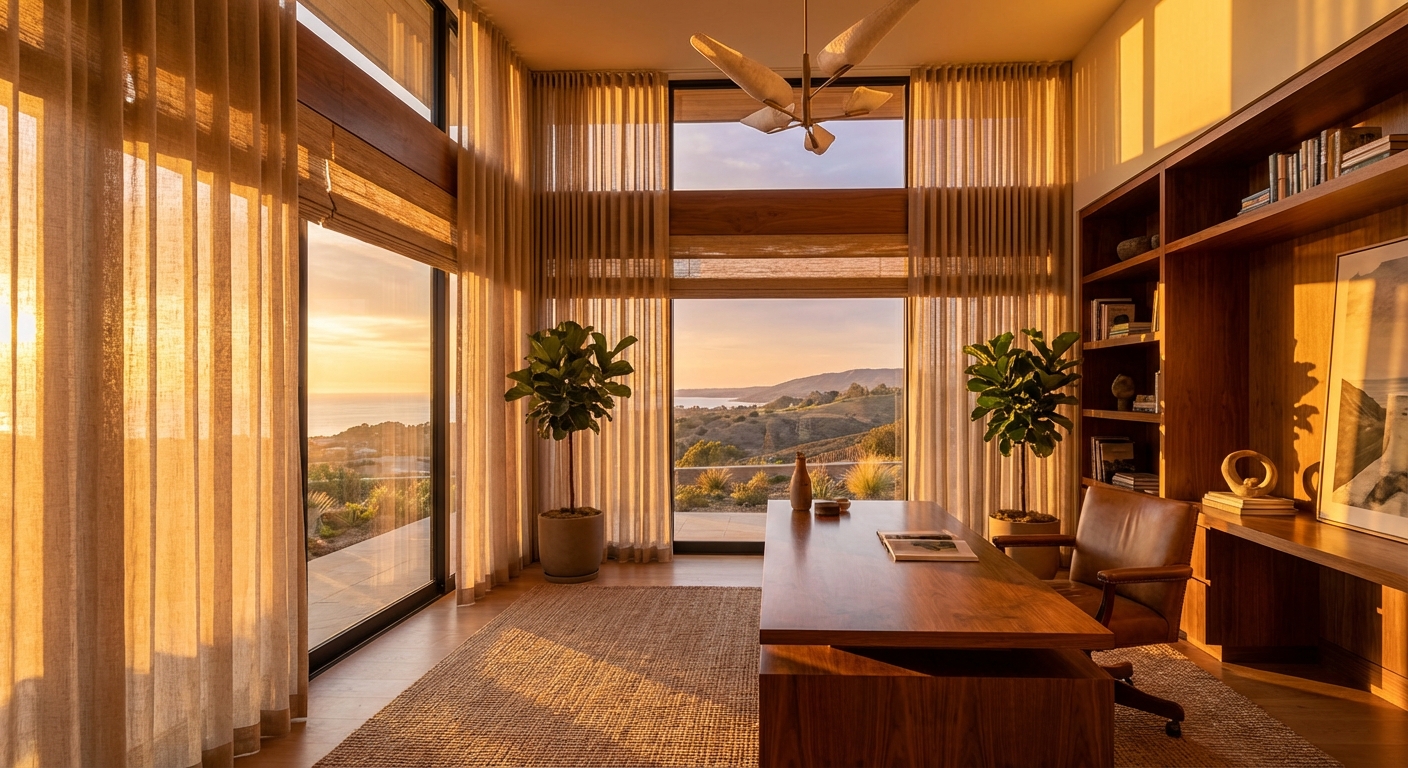
On a slider, drapery is underrated. Extend the rod 12 to 18 inches past each jamb and the panels stack on the wall, not on the glass, so open means genuinely open. Ripplefold hardware stacks tighter than pinch pleat. Fabric also does something hard surfaces don't: it softens the echo in a tall great room and reads as furniture rather than hardware. The catch is traffic. Panels get pushed, dragged and, with a dog, chewed at the hem. Lined drapery on a heavily used pool slider in Lake Sherwood or Spanish Hills is a maintenance decision, not just a style one. $800 to $2,500 per window depending on fabric, lining and width.
Roller and solar shades
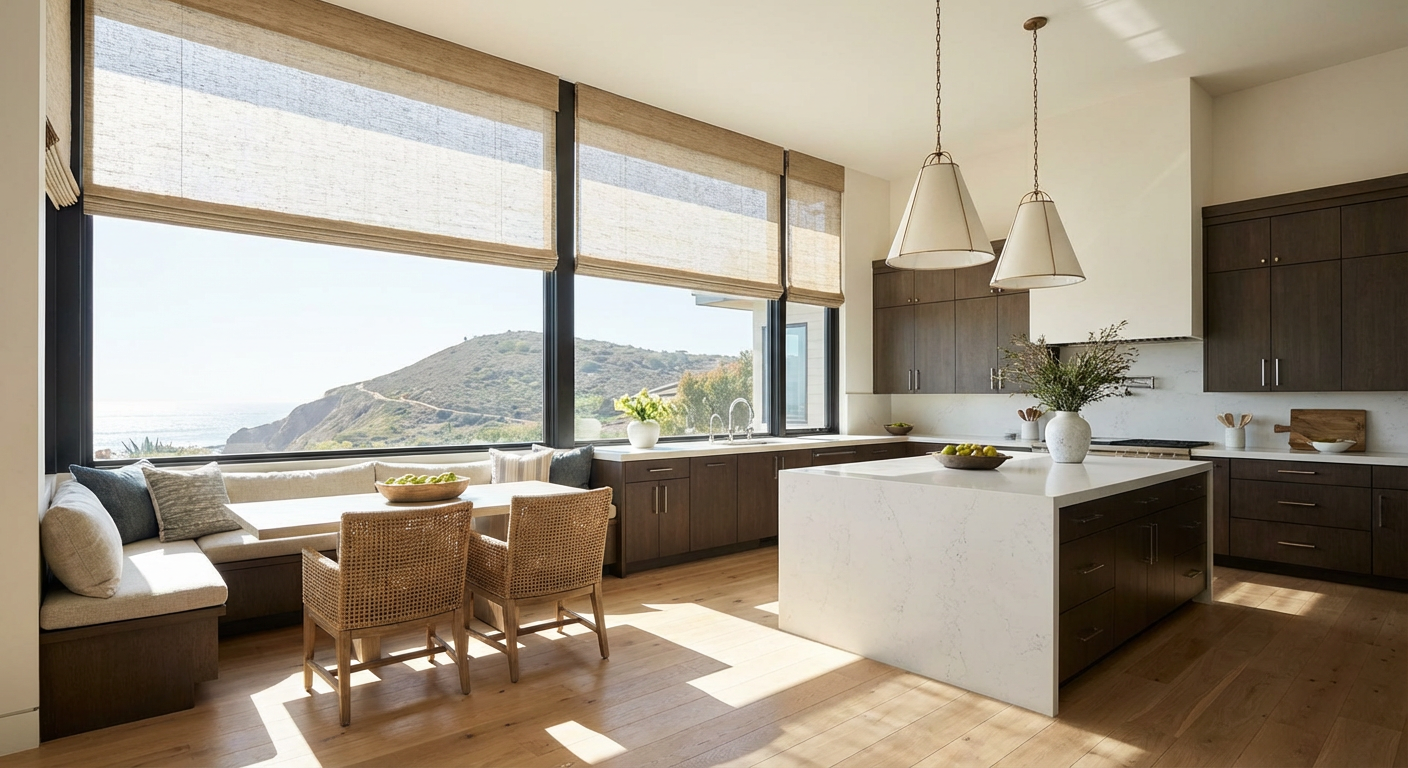
Best heat and glare control per square foot, zero stack over the glass, and the cleanest look on a modern elevation. A 3 or 5 percent solar screen on a west-facing slider in Camarillo or Moorpark cuts the 4pm glare while you still see the yard. The problem is the door. A shade has to go all the way up before you walk through and all the way down when you want it back, and on a wide door that's a slow chain pull. Motorization mostly fixes it — $200 to $500 per window added — but on a truly high-traffic door you'll still be hitting a button all afternoon. $495 to $955 per window for the shade itself on a typical opening; a wide slider often runs two shades on one headrail.
Wood and faux wood blinds
Horizontal blinds work on a slider only as a vertical-style bank, and we generally steer people away. They're the cheapest path at $250 to $650 per window, and on a door they're the most likely to end up bent.
Pick by how the door gets used, not by what looks best online
- Main patio or pool door, constant traffic, kids and dogs. Bypass shutters if you can live with half the glass covered, panel track if you can't. Both stay put when someone barrels through.
- Dining room or bedroom slider you open twice a month. Roller or solar shade. You get the whole opening back and the best heat performance on the wall that needs it.
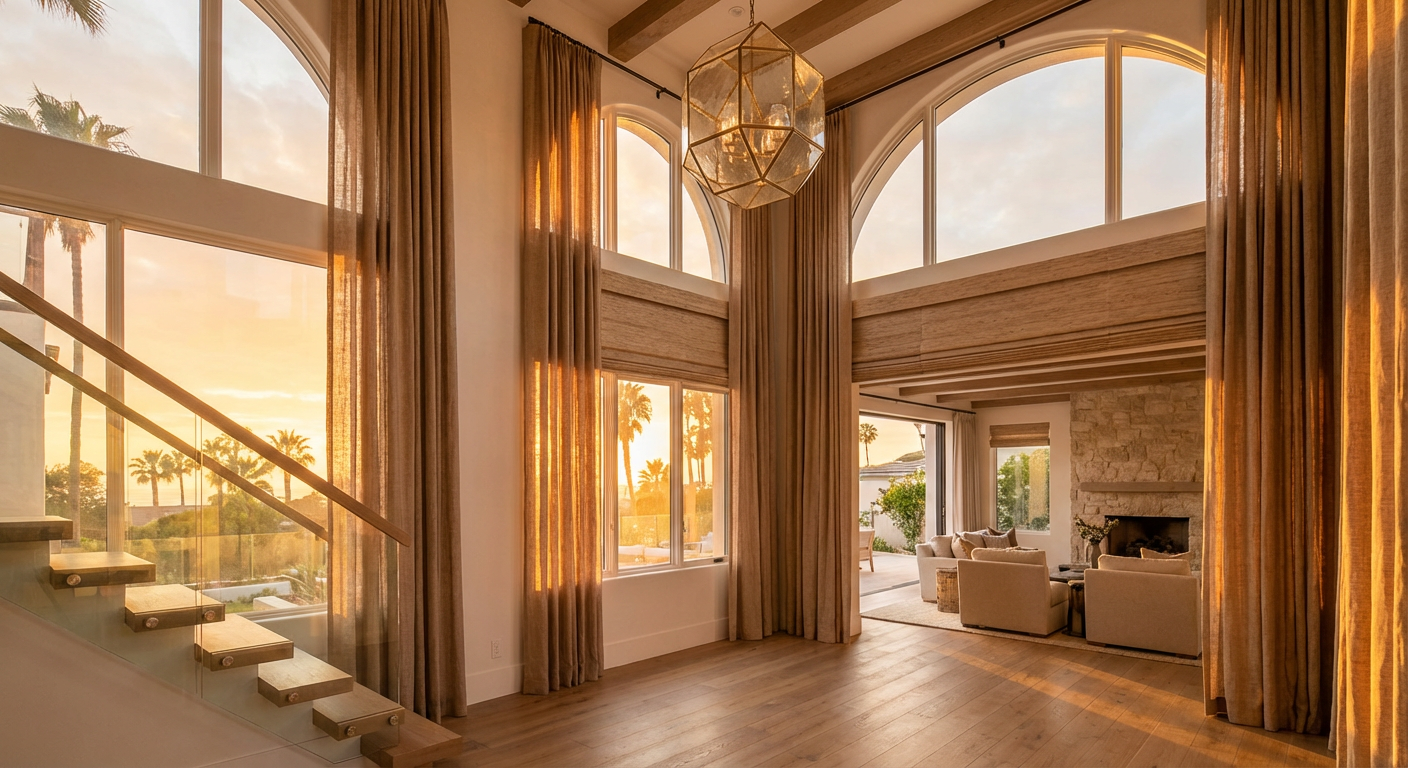
- Two-story great room wall with a slider plus transoms. Shutters on the slider for durability, a solar shade above for the heat. We wrote about splitting products this way across a house in shutters versus shades on the hot rooms of a Conejo Valley house.
- Slider that's really a view wall. Drapery on an extended rod, or nothing on the glass at all and shading handled outside.
- Matching a whole house. Shutters everywhere except the two or three openings that cook, which is the most common configuration we install in Ventura County.
Before you buy: measure the swing, the handle and the header
Sliders fail in installation more often than in specification. The things that decide whether your chosen product actually works are the door handle projection (shutter panels have to clear it), the header depth for an inside-mount roller, floor clearance for bifolds, and whether the opening is square — 1980s and 1990s tract sliders in Simi Valley and Oxnard frequently aren't.
That's why we measure in person before quoting a door. Someone comes to the home, measures every window, brings real samples you can hold against the glass and the floor, and you get a firm quote with installation included. The in-home consultation is free. Book a measure, or if you already have a bid in hand, upload it to Quote Check and we'll tell you what's in it.
Frequently asked questions
What is stack-back on a sliding glass door?
Stack-back is how much of the opening the treatment still covers when it's fully open. On a 96-inch slider, a panel track typically stacks 26 to 36 inches over the glass, a bypass shutter covers about half the door permanently, and drapery on an extended rod or a roller shade covers none of it. It's the number that decides most slider choices, so ask for it before you sign.
Can you put plantation shutters on a sliding glass door?
Yes, usually as bypass panels that slide on a track or bifold panels that fold back against the wall. Bypass keeps half the opening covered at all times; bifold clears more glass but projects into the room and needs floor clearance. Both keep the tilt function, so you can manage privacy and glare without moving the panels, which is why they work well on doors used many times a day.
Are panel track blinds better than vertical blinds?
For most homeowners replacing worn verticals, yes. Panel tracks use a few wide fabric panels instead of dozens of loose vanes, so there are far fewer parts to break and nothing clatters in a Santa Ana wind with the door open. The trade-off is no tilt — a panel either covers glass or it doesn't — and a wider stack than a vertical blind.
What does a shutter on an 8-foot slider cost?
Plantation shutters run $55 to $106 per square foot installed, with a 12 square foot minimum billable per opening. An 8-foot by 7-foot slider is roughly 56 square feet, so it's typically one of the larger single lines on a whole-home quote. Installation is included in our quoted prices.
Should I motorize a roller shade on a patio door?
If the door gets daily traffic and you still want a roller shade, motorization is close to mandatory — a wide, tall shade is slow to raise by chain. Figure $200 to $500 per window added. On a slider you only open occasionally, a manual shade is fine and saves that cost.
In Ventura County? Get a free quote from a local installer
Serving Thousand Oaks, Newbury Park, Westlake Village, Oak Park, Simi Valley and nearby.
- Quote from your window sizes and photos, usually the same day
- See real samples in your space
- We carry every major manufacturer